
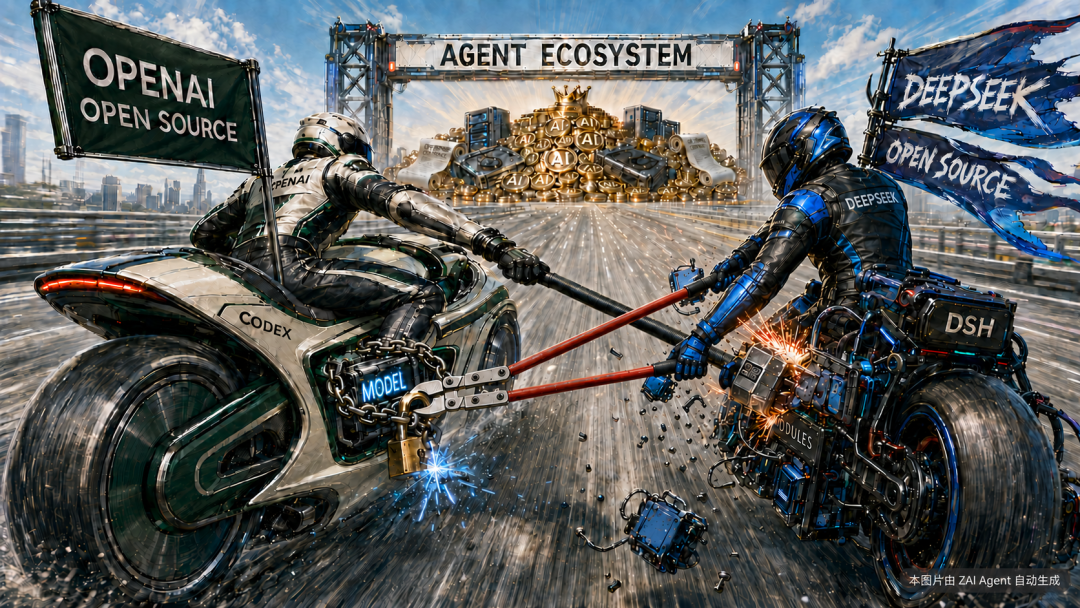
When open source threatens profits, it's called "Full AI Communism"; when open source can expand business, it's called an ecosystem. Open source doesn't tear down the walls; it just moves them to more valuable places—that's all.
- The open floors are not the same. Codex offers open molding capabilities, while DSH offers open assembly rules; behind these two Harnesses lie two different businesses.
- Open source depends on how you make money. Models remain scarce, and Harness is responsible for channeling revenue generation capabilities into more products.
- Ecological war redraws lines OpenAI hopes that the ecosystem will grow around the model, while DSH wants to prevent any model from locking up the ecosystem.
The open-source battle in the AI industry is now escalating from models to the foundation of agents.
In just one week, DeepSeek and OpenAI raced to open-source their agent platforms: the former open-sourced DSH, and the latter open-sourced Codex Harness. What were once considered closed systems that provided a commercial moat have now become historical burdens that both companies are eager to shed.
It seems that after the model is open-sourced, the agent will also need to be open-sourced; Chinese companies are opening them up, and American companies are following suit. But the problem is that about a month ago, Dean Ball, the head of strategy and future of OpenAI and former White House AI policy advisor, was still making outrageous remarks about Chinese companies' move to open up their models.
Ball, an executive at OpenAI, claimed that open models would diminish the commercial returns of cutting-edge AI and discourage companies from continuing to invest tens of billions of dollars, thus being a natural "deceleration force." Not content with just discussing capital returns, he then resorted to his infamous ideological tactics, describing Chinese companies' open-source strategies as "full AI communism," conveniently packaging a commercial competition about costs, profits, and market share as a battle of systems.
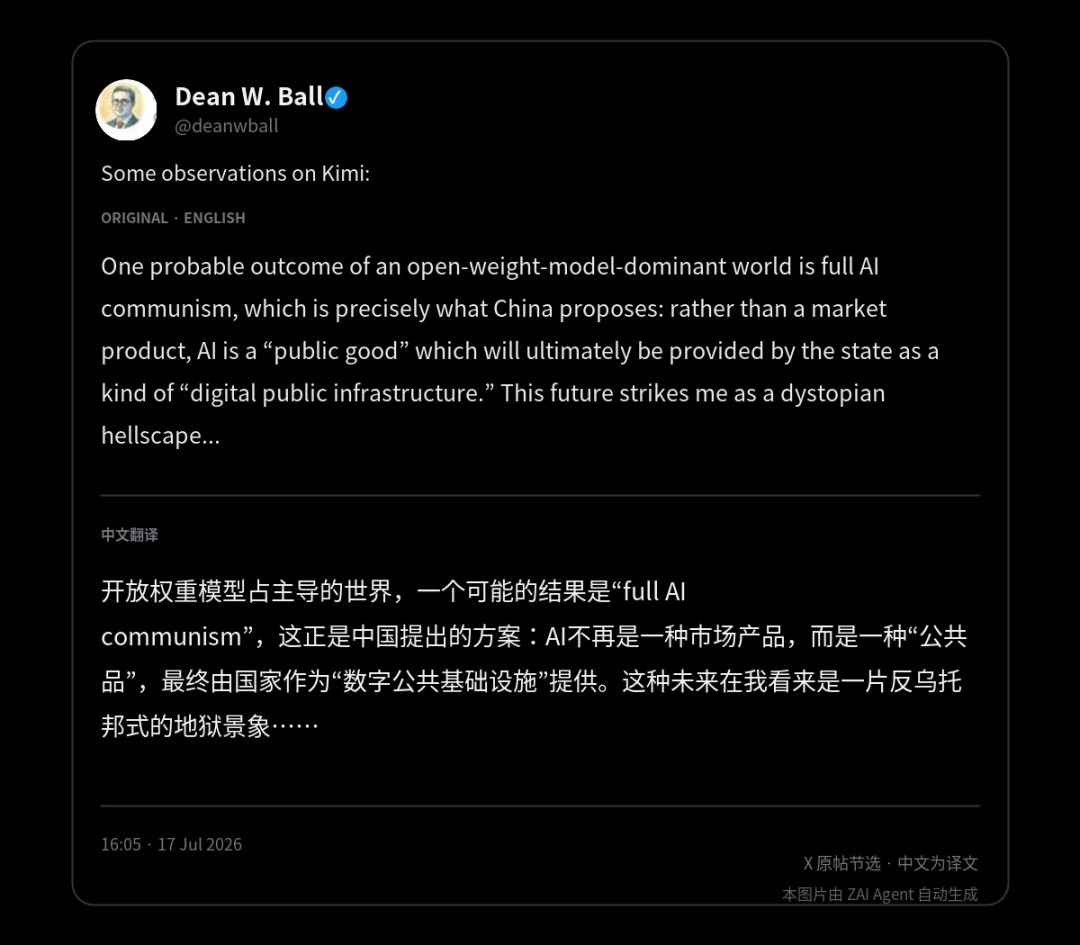
Following this logic, locking the model into the API and keeping the core capabilities on the servers of a few American companies is the way to protect technological progress; if Chinese companies open it up, it becomes a viable ideological action. Ball's statement is almost a public attempt to distance himself from the word "open."
But a month later, before Ball's words had even fully taken effect, the seemingly invincible OpenAI also betrayed the revolution, slipping into the open-source camp and taking a rather prominent position.
If open source truly undermines commercial returns, why did OpenAI release Codex Harness? Is this a self-denial forced by competitive pressure, or is Ball's real opposition not to open source, but to Chinese companies using open source to gain a commercial advantage?
More importantly, although both DSH and Codex Harness are called "open source," what exactly are they opening up, and what are they protecting respectively? Are they embracing the same technological ideal, or are they using open source to attack each other's commercial territory?
Behind the answer lies an ecological battle that has spread from the model to the agent's foundation.
Both are open source, but this open source is not the same as that open source.
In the tech industry, "open source" isn't just about whether the door is open; more importantly, it's about what's inside. Some open up showrooms of finished products, some open up component assemblies, and some open up doors filled with screws, yet still prominently display the words "Open Source" in gold lettering. ...The situation is similar here. Although OpenAI and DeepSeek have both open-sourced Harness, the specific content and even the business models are quite different.
Let me explain Harness in the simplest way possible.
The large model is mainly responsible for understanding the problem, making judgments, and generating the next action, but opening files, running commands, calling browsers or enterprise software, and returning the execution results to the model all require another system to complete; a very accurate analogy can better illustrate the relationship between the model and Harness: the model is the train, and Harness is the track system, which can support, limit and guide the direction of the train.
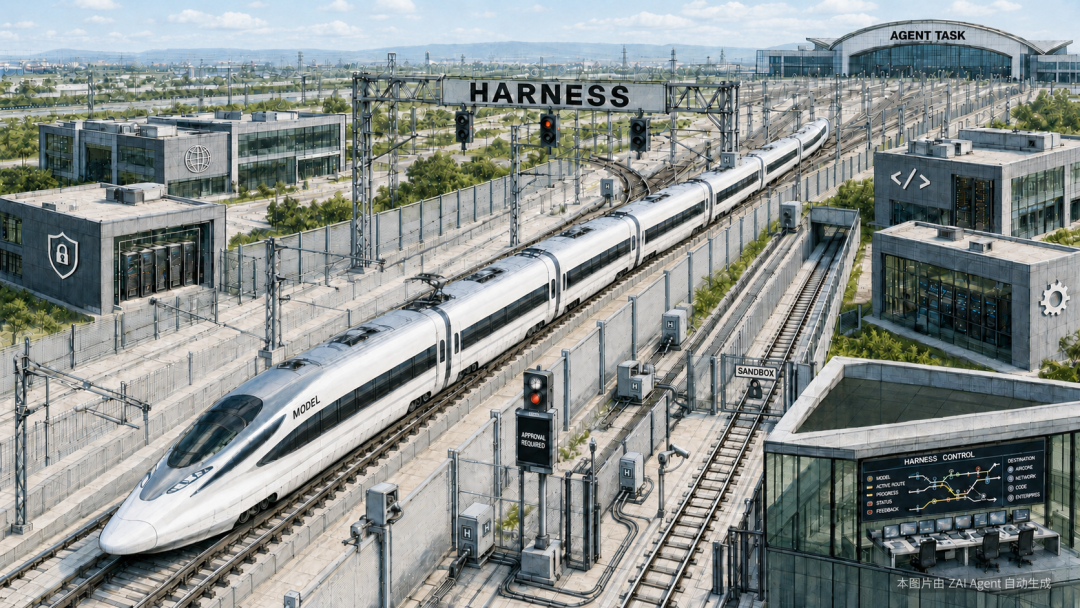
Specifically, Harness handles this part of the work: it connects the model, tools, and users, breaking down tasks, calling tools, recording progress, and driving the model to continue making judgments based on the execution results. When encountering sensitive operations such as money transfers or file deletions, it can also pause the task and wait for user approval.
With Harness, the model can transform from simply answering questions to becoming an agent that continuously performs tasks. This execution system, situated between the large model and the specific application, is Harness.
Although both companies are offering Harness, their approaches differ. OpenAI is providing a fully-developed Codex capability, hoping developers will integrate it into more products; DeepSeek, on the other hand, is offering a modular Agent foundation, hoping developers will create components according to the interfaces and rules defined by DSH, and then assemble models, tools, and expertise into truly deliverable Agent products.
OpenAI is opening up Codex Harness, with the key goal of enabling external products to directly use the task execution capabilities already established by Codex.
Developers can customize Codex's interface, integrating their own software, data, and business processes to transform it into a code review, enterprise operations and maintenance, or financial month-end closing agent. OpenAI's App Server handles the transmission of Codex's execution progress, tool calls, and approval requests to external products, eliminating the need for developers to rewrite the entire agent's runtime logic.
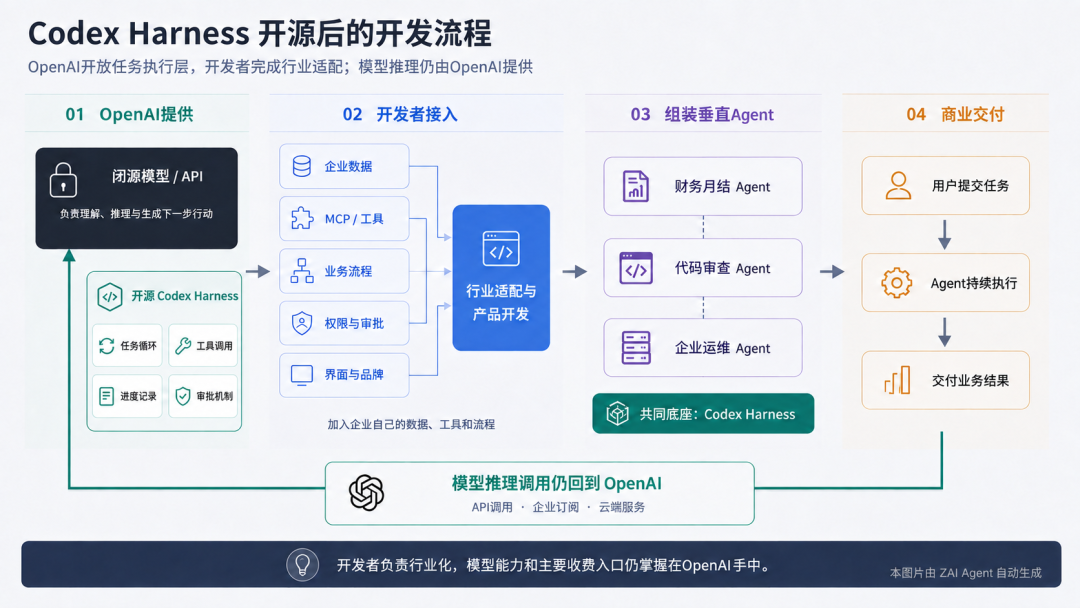
In theory, a financial software company can connect a company's financial system, month-end closing processes, and permission rules to Codex to develop its own month-end closing agent. After all, finance personnel don't care whether the agent loop is elegantly written; they only care whether they can find discrepancies at the end of the month and whether the agent will accidentally delete the general ledger.
The final product can utilize the financial software company's brand, interface, and industry knowledge, while the core of task execution still comes from Codex. Developers are responsible for the last mile of industry adaptation, allowing the same Codex capabilities to be applied to more software and business scenarios.
DeepSeek opens up DSH, focusing on allowing developers to develop components and assemble agents according to its defined rules.
It also provides a default solution that can be run directly, but the model, tools, sessions and storage, sandbox, interface, and even the workflow of how the Agent repeatedly judges and executes are all designed as replaceable components. Developers can either use the combination provided by DeepSeek directly, or redevelop any part according to the interface defined by DSH.
The key point here is not that "anything can be replaced", but that the new components still need to follow the assembly rules set by DSH.
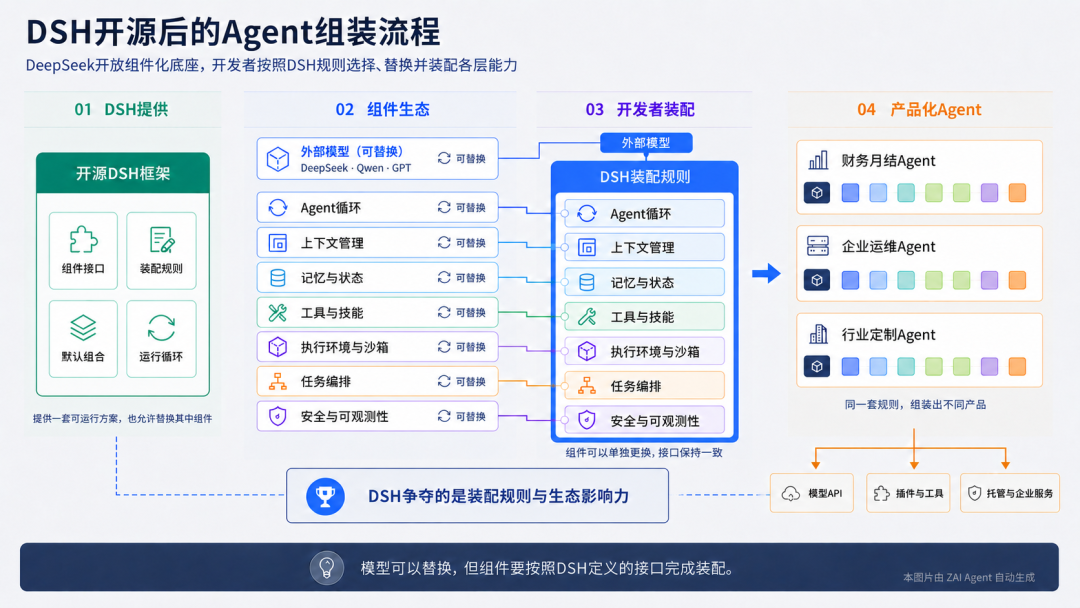
Taking the financial month-end agent as an example, developers can choose a model to handle task judgment, use a component to connect to the financial system, and then connect to the enterprise's own permissions, memory, and security sandbox. If the model's price increases in the future, only the model needs to be replaced; if the enterprise raises security requirements, only the sandbox needs to be replaced, and other parts that have already been developed do not need to be replaced.
These components come from different companies but follow the assembly rules defined by DSH. Companies can select parts according to their actual needs and then assemble them into a complete agent product. If this development approach is widely adopted, DSH will no longer just provide a set of open-source code, but could also become a common interface for different models, tools, and expertise to enter agent products.
The difference becomes even more apparent when these two open approaches are applied to the physical robotics industry.
Codex is like a fully calibrated robot. Its basic form and control logic are already defined, and developers can equip it with fixtures, barcode scanners, or welding torches, and then integrate it into warehouse sorting, quality inspection, and automobile assembly processes to perform different tasks.
DSH is more like a robot assembly platform: you can choose between bipedal, quadrupedal, or wheeled systems; the joints can be lightweight or upgraded with high torque and force feedback; the end effector can be a gripper or a tactile dexterous hand; and the sensing system can be either LiDAR or binocular vision. All components are assembled according to the interfaces defined by DSH.
Codex allows developers to extend a pre-defined robot, while DSH allows developers to assemble an entire robot according to its defined interface.
The two open-source methods are different, and naturally, the paths to making money are also different.
OpenAI's financials are relatively straightforward; it doesn't even need a senior accountant. Harness can be free, but products built around it still require models, computing power, APIs, enterprise subscriptions, and cloud services. The more industries Codex enters, the greater the demand for these paid capabilities will be.
A third party acts as a financial agent; OpenAI may not receive licensing fees for the software, but it could potentially gain long-term revenue from model calls and enterprise services. It forgoes developing each application itself in exchange for more applications continuously consuming Codex. The software can bear someone else's trademark, and API bills can still potentially reach OpenAI.
DSH is a bit more complicated because it allows developers to replace the DeepSeek model as well.
DeepSeek's primary goal is for DSH to become the foundation developers habitually use when assembling agents, allowing different models, tools, and specialized components to connect according to this architecture. Once a developer entry point and plugin ecosystem are established, DeepSeek will have the opportunity to gain standard influence, and its own models will be more easily integrated into various agents.
The models are replaceable, and price and performance are directly compared. For a challenger vying for market share with low cost and high performance, this may not be a bad thing. As long as DeepSeek models are cheap enough and powerful enough, lowering the switching barrier may actually expand its API usage and enterprise adoption. Future hosting, technical support, and enterprise services may also be built on this ecosystem.
Ultimately, OpenAI hopes that more products will adopt Codex, enabling the same set of agent capabilities to continuously generate revenue in different scenarios; DeepSeek hopes that more companies will develop components according to DSH rules, push it towards a universal assembly standard for agents, and then let their models and related services benefit from the expansion of the ecosystem.
Both companies offered Harness for free, but what they really wanted to expand was another business behind Harness.
Just after criticizing open source, why did OpenAI turn around and start its own?
As mentioned earlier, OpenAI did not release its most expensive model when it made Codex Harness available. This precisely demonstrates that OpenAI's judgment on whether a technology should be made available is not based on some abstract stance, but rather on how it will affect its core business.
Leaving aside the notorious and nauseating ideological packaging, Ball's business judgment does indeed align with OpenAI's interests: Chinese companies opening up high-performance models could potentially drive down model prices and weaken the ability of cutting-edge labs to recoup their huge training investments.
Training cutting-edge models requires significant investment in chips, data, power, and engineering. Labs typically aim to recoup these costs through APIs, subscriptions, and enterprise services. Once open models with comparable capabilities become available, customers can deploy them themselves or choose cheaper vendors, shortening the time it takes for leading companies to maintain their high prices and technological advantages.
According to Ball's logic, declining model prices will weaken the return on investment, ultimately reducing companies' willingness to continue investing in the next generation of models. This is what he calls the "force of deceleration."
However, this logic applies to the model and may not necessarily apply to Harness.
Having cutting-edge models with capabilities doesn't mean users can directly experience those capabilities, nor does it mean they can automatically translate into commercial revenue. Models must be integrated into specific products, acquiring tools, interfaces, and task flows to truly solve problems. Dianne Penn, Product Manager of AI Research and Labs at Anthropic, illustrated this relationship in an interview using Opus 4.5 and Claude Code as examples: Opus 4.5's capabilities gained a clearer product embodiment through Claude Code, and Claude Code's rapid adoption was built on the foundation of sufficiently strong model capabilities. Models and products are not independent; the former determines the upper limit of capabilities, while the latter is responsible for ensuring users actually use them and are willing to pay for those capabilities.
This also explains why OpenAI is willing to open up Harness. Opening up the model might allow some customers to deploy it themselves or switch to lower-priced vendors, thus weakening OpenAI's pricing power. Opening up Harness, however, allows more developers to incorporate Codex into their products, enabling the model to enter financial, legal, healthcare, and enterprise software sectors that OpenAI cannot directly cover.
One approach might reduce OpenAI's opportunities to sell its model capabilities, while the other increases the scenarios where models are used and charged for. Ball's criticism of open models and OpenAI's opening of Codex Harness are both logically sound.
As for why Ball insists on packaging a business issue as an ideological one, it's not easy to judge from the perspective of mindset and moral character. However, whether "openness" is dangerous depends on whose things are being made public and whose profits are being affected. Ball is indeed quite clear-headed about this.
Ideological circles are responsible for drawing clear lines at press conferences, but when it comes to money, they can draw a new line as needed.
What to open up depends on how to make money.
This approach of "holding the core while opening up the periphery" is neither a brilliant stroke of genius from OpenAI nor some profound and unfathomable top-level strategy. Its principle can be explained in a simple sentence: the company is willing to open up the parts that can expand the market, while keeping the scarce capabilities that truly determine profits in its own hands.
NVIDIA, also at the heart of the AI industry, understands this well. While it open-sources tools such as TensorRT-LLM, Triton, and NeMo, it maintains firm control over the hardware and software platform comprised of GPUs and CUDA.
CUDA is particularly crucial. GPUs provide computing power, while CUDA connects programming tools, acceleration libraries, and performance optimizations, allowing a vast amount of software, talent, and workflows to converge around NVIDIA's platform. The richer the upper-layer tools, the more models and applications developers provide, and the greater the demand for the GPU and CUDA ecosystem.
This is certainly not charity; it's just a business deal. Developers get free tools, and NVIDIA gets more workloads running around CUDA. It simply knows exactly which code, once made free, will lead to more GPU sales.
OpenAI employs a similar division of labor within the industry. It cannot develop all financial, legal, medical, and investment agents in-house, so it opens up Codex Harness, outsourcing the last-mile industry customization to software vendors, while concentrating its resources on models, inference services, and enterprise clients.
NVIDIA hopes the market will create more scenarios that consume GPUs, while OpenAI hopes the market will find more scenarios that consume model inference. Both follow the same principle: control the scarcest and most scalable cores, and leave the complex and decentralized peripheral innovations to the market.
OpenAI hasn't changed its business model; it has simply redefined its boundaries: the model is responsible for maintaining scarcity and charging fees, while Harness is responsible for getting the model into more products.
It is only willing to open up the parts that can make the core assets more valuable.
Northwest Shanxi is in complete chaos: a chaotic battle over open ecology.
After OpenAI and DeepSeek opened up Harness, the AI industry did not move towards uniformity. On the contrary, the parts that both companies chose to open up were precisely those that targeted each other's weaknesses.
It needs to be clarified that Codex Harness could not have been developed in the last few days after the release of DSH. Therefore, it is wrong to conclude that OpenAI open-sourced it specifically to counter DeepSeek just because the two news items were released less than a week apart. Such a view is very emotional but has little value.
However, it is also necessary to clarify that business competition is not only about why a project was initially initiated, but also about whose space it actually squeezes after its launch.
Codex and DSH: A de facto commercial crossfire
OpenAI has first and foremost made "Open Harness" no longer a unique advantage of DSH. Developers can remain within the OpenAI ecosystem and still integrate their own software and processes to develop vertical agents; they can also use Codex's ready-made models, products, and enterprise services. For companies that simply want to deliver products as quickly as possible, maturity and convenience are often more attractive than complete freedom.
Therefore, OpenAI doesn't need to be more open than DSH; it only needs to be open enough that developers have no reason to leave. Codex's challenge to DSH is to reduce the appeal of "free assembly" by using a shorter delivery path.
DSH attacks the very ecosystem that OpenAI is most eager to protect. It turns models into replaceable components, allowing companies to retain tools, memories, permissions, and business processes, only needing to change the backend model.
GPT can still be integrated into DSH, but its role has changed: within the Codex ecosystem, it was the product center; within DSH, it's simply one of many suppliers comparing prices and capabilities with models from DeepSeek, Qwen, and others. DSH doesn't even need to guarantee DeepSeek's victory every time; as long as companies believe models can be replaced, OpenAI's ability to lock in customers and maintain high prices using its entire agent system will decline.
Tools and business processes developed according to DSH rules will not naturally be embedded in the Codex ecosystem. For the private deployment and deep customization market, enterprises can also decide for themselves who provides each layer.
Therefore, DSH's attack on OpenAI is to reduce OpenAI from a platform owner to a model supplier.
OpenAI opened Harness to allow the ecosystem to grow around its own model; DSH opened Harness to prevent any model from locking up the ecosystem through Harness.
Anthropic: If the enemy makes a move, I won't move first; if the enemy wants to stab me, then I might have to move.
With OpenAI and DSH both launching Harness, it remains unclear whether Anthropic will follow suit. Based on its current strategy, it will most likely adopt a wait-and-see approach first.
Anthropic monetizes through Claude's API, subscriptions, and enterprise services. As long as its model capabilities are strong enough and enterprise customers are willing to pay for stability and security, it has no pressing reason to dismantle its core agent system. Compared to OpenAI and DSH, Anthropic currently places more faith in the value of a complete product than in the speed of expansion that comes from opening up its underlying infrastructure.
Dario Amodei's personal preferences also influence this choice. He is not against all open models and explicitly acknowledges that open models without dangerous capabilities have public value; however, for high-performance models, he consistently emphasizes one issue: once weights are made public, they cannot be withdrawn, and existing security restrictions and usage monitoring may become invalid.
This tendency only indicates that Anthropic is more cautious about openness, and cannot be directly inferred that it necessarily opposes open-sourcing Harness. After all, model weights and Harness belong to different levels, and opening up the task execution system does not equate to handing over Claude itself. Dario's risk-averse perspective is more likely to determine the boundaries of openness, rather than permanently sealing off all possibilities.
The real variable remains market pressure. If Codex and DSH attract a large number of developers by opening up Harness, Claude may gradually become an alternative model provider for other agent systems. Even if Anthropic can still sell its API, it may lose influence over product entry points and the ecosystem.
Logically, one possibility is that Anthropic might try to open up a model with relatively controllable capabilities, or open up some form of Harness, to lower the barrier for developers to build products around Claude, while continuing to hold onto the most advanced model and main commercial services.
There is currently no evidence that it is prepared to do so, so this can only be considered a deduction based on the competitive landscape. However, if opening up Harness gradually transforms from a bonus into an entry ticket to the agent market, Anthropic will find it difficult to answer business questions forever by relying solely on its closed-source belief.
Dario can decide how wide Anthropic initially opens the door, but OpenAI and DSH may determine how long that door will remain open.
Google Gemini: Basically nobody's poking me, and I don't want to move.
Google actually open-sourced its Agent development framework, ADK, back in 2025. It didn't generate the level of discussion we see today, mainly because ADK was just a newly released framework, not a disassembled Agent product with a large user base. At the time, the industry hadn't yet considered Harness as an independent platform layer, and ADK was included in Google Cloud Next's 229 releases, ultimately being treated as just another SDK: technically ahead of schedule, but without any newsworthy developments.
Therefore, with Codex and DSH opening up their platforms, Google didn't need to rush to follow suit. It had already done something similar, just without packaging it as an ecosystem war.
More importantly, Gemini is currently only one part of Google's vast business. Alphabet has not yet disclosed revenue from Gemini separately, while Google Cloud is a mature business with separately disclosed revenue and profit. In the AI industry chain, Google's clearer commercial returns still come from infrastructure such as computing power, model hosting, storage, databases, and enterprise services.
Google certainly wants more agents to use Gemini; but even if developers choose other models or Harness, as long as the related business runs on Google Cloud, it can still make money. OpenAI and DSH need to compete for who assembles the agents, while Google has both its own models and the infrastructure to support various agents. It wants Gemini to win, but it doesn't need to bet its entire business on Gemini's sole success.
Open source has not eliminated walls.
What's truly noteworthy in this debate isn't who suddenly embraced open source, but rather who is redefining industry boundaries.
Open source in the agent era is essentially a redistribution of the free and paid layers. Companies open up the parts they want to popularize quickly, and then use the resulting ecosystem to enhance the value of their core businesses.
The real winner is not necessarily the one that offers the most open-source components, but rather the one that enables the entire industry to use its open-source parts while ultimately relying on its closed-source core.
Open source didn't tear down the walls. It just moved them somewhere more valuable.