

Capital markets can price imagination; consumer markets only pay for use.
- Do families need independent computing power?
- Homes have computing power needs, but not necessarily high computing power needs.
- A good story ≠ a good business
“"The best alarm clock under 10,999 yuan"”
A while ago, a video filmed at the WAIC event circulated in various WeChat groups, providing a lot of laughs for onlookers. In the video, several visitors surrounded a home AI computing product called AI Cube, which was being exhibited by Moore Threads and priced as high as 10,999 yuan. They posed a potentially disastrous question to the staff on site: "What's the point of buying this thing?"“
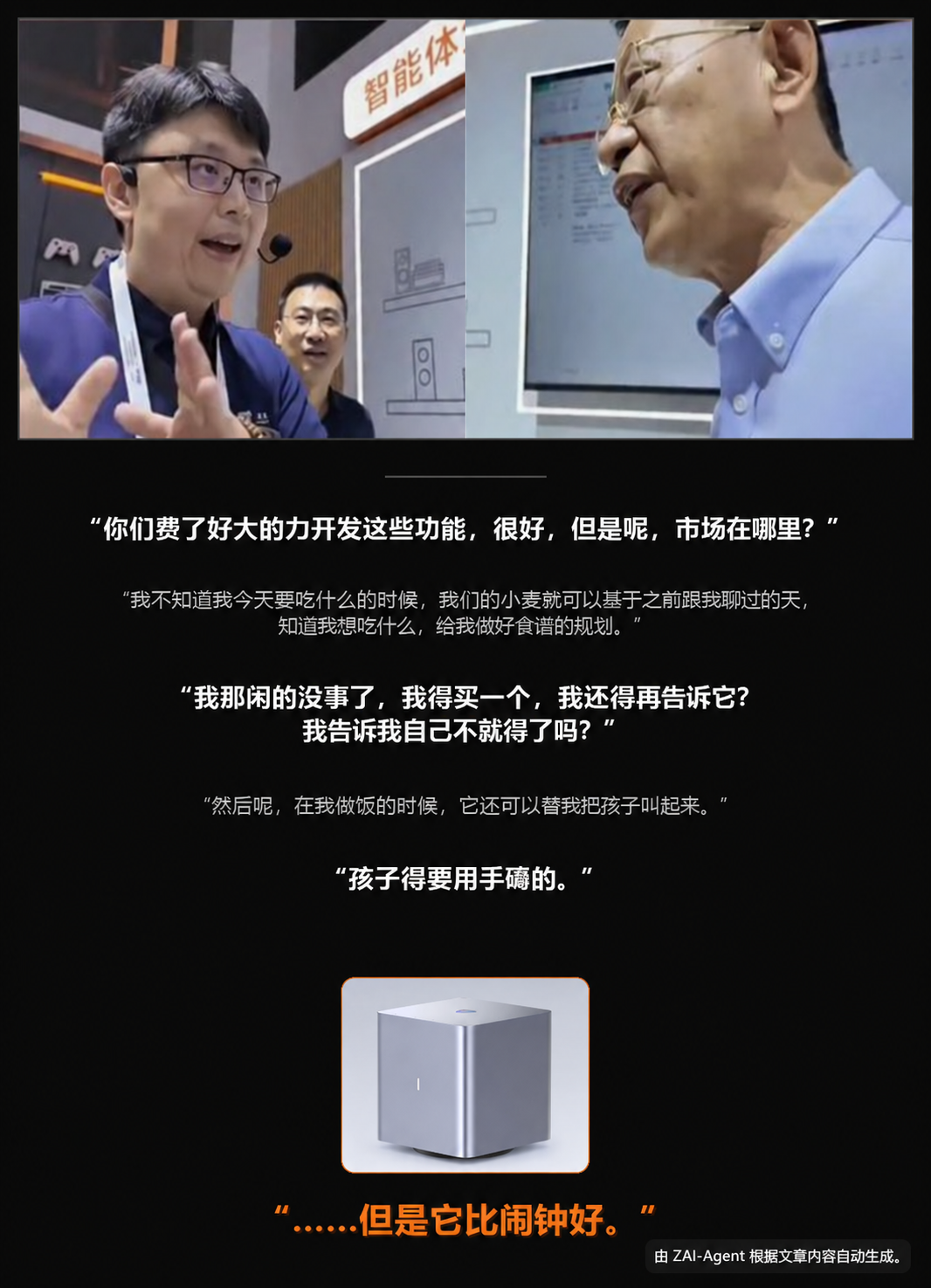
Normally, when faced with such a blunt question, the product manager, disguised as a marketing or public relations colleague, would have already started rambling on with pre-written scripts. However, Moore Threads, as an engineer-oriented company (at least judging from the on-site staff), clearly didn't intend to adopt such a conservative strategy. The young men on-site immediately switched into development mode, earnestly discussing the use cases with the questioner. After being shut down twice, they finally answered the overwhelming question with a single sentence: "But it's better than an alarm clock."
Edge computing power platform: a new category of AI hardware
“The claim of "the best alarm clock under 10,999 yuan" is obviously a joke; this small metal box, priced over 10,000 yuan, does indeed boast impressive specifications. The AI Cube is equipped with Moore Threads' self-developed "Yangtze River" smart SoC, which integrates the CPU, GPU, NPU, and video processing unit into a single chip. The CPU has a maximum clock speed of 2.65GHz, achieving a heterogeneous AI computing power of 50 TOPS, while also featuring 32GB of unified memory and 120GB/s memory bandwidth. Besides running large local models, it also possesses graphics rendering, video encoding/decoding, and general computing capabilities. Coupled with all-flash private cloud storage, Moore Threads clearly aims to make it the go-to solution for AI interaction, multimedia entertainment, home office work, and data management in the home.
Moore's Threads isn't the only company eyeing this business. Lenovo's AI Host P7 also made an appearance at WAIC. It's equipped with the Moore's M50 chip, boasting a local AI computing power of 190 TOPS, up to 80GB of memory, and supports 128K context and local large models with up to 122 billion parameters. Even in a completely offline environment, the company claims its inference speed can still reach up to 50 tokens per second.
50 TOPS AI Cube
190 TOPS Lenovo AI Host P7
These two devices have chosen different product strategies. The AI Cube is more like a small computer with an AI hub, aiming to handle computing, storage, and entertainment simultaneously; the P7, on the other hand, focuses more resources on large model inference, with Lenovo hoping it can be accessed by mobile phones, computers, and other smart terminals, acting as a portable "local token factory." However, after going around in circles, both companies are still doing the same thing: selling users a separate local computing power device in addition to mobile phones, computers, and smart home devices.
According to the respective statements released by the two manufacturers, from 50 TOPS to 190 TOPS, the arms race for computing power in the home seems to have already begun ahead of schedule. The real question now is no longer which machine has a more impressive configuration list, but rather a more practical one: what kind of experience can local computing power actually bring to users, and how much value can it create that is worth paying for?
Local computing power has been used for a while now, but households may not necessarily need to buy another one.
Fortunately, the answer to the first part of the question is already quite clear: by now, the value logic of edge computing power and large models has become basically clear, and a number of basic capabilities have begun to be incorporated into actual products.
At a technical forum hosted by the China Computer Federation at the end of 2025, themed "Exploring the Development Path of Large-Scale Edge Models," experts summarized the core value of edge computing power + large-scale models: low latency, high reliability, privacy protection, data sovereignty, and offline scenarios. Observing existing AI services based on this conclusion, you'll find that real-world examples focus on office scenarios. Copilot + PC is a relatively representative example: at least 40 TOPS of NPU provides computing power support for edge functions such as real-time captioning, video call effects, image generation, and super-resolution.
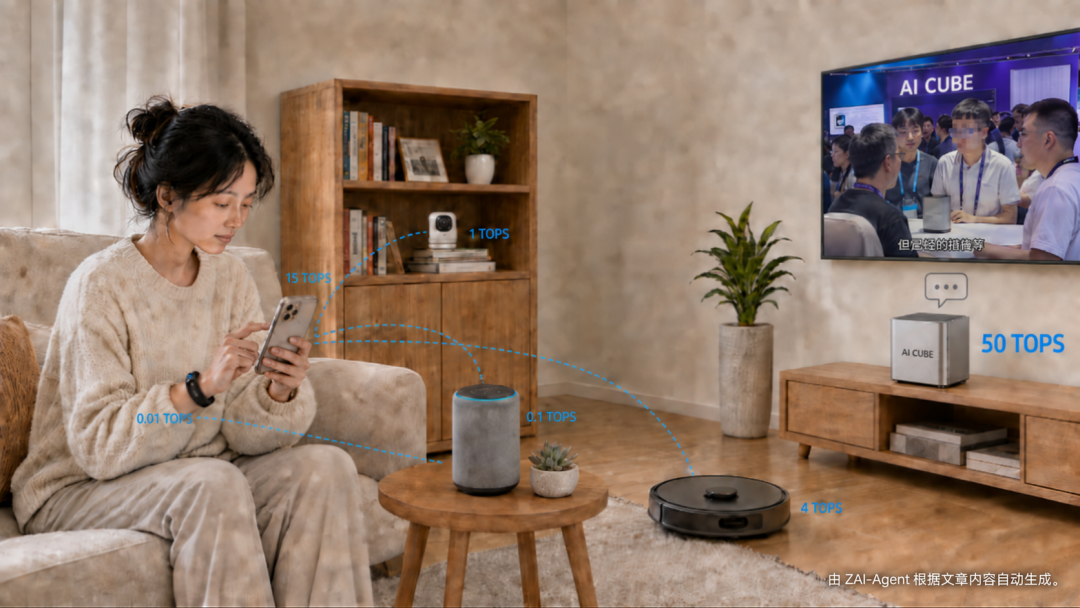
Continuing along this line of thought, there are actually quite a few scenarios in family life that require local computing: cameras need to recognize human figures, crying sounds, and abnormal activities; smart speakers need to complete local wake-up and basic command recognition; mobile phones are responsible for photo classification and facial recognition; and watches continuously record health data—privacy, latency, and availability even when the network is down are all valid reasons in the home.
However, please note that there is a key difference between home and office scenarios: the location of edge computing power.
Compared to the highly centralized office environment centered around PCs, where edge computing power and large models are built into PCs, the computing power and models in the home environment are relatively dispersed. Cameras, NAS devices, smart speakers, smartwatches, and mobile phones all have edge computing power and modeling capabilities and have formed very mature business models. Each has its own independent R&D, marketing, and sales system. A large number of service requests related to edge computing power have already closed loops on their respective devices, and the data results can be displayed or applied further on their own or related devices. There is no strong reason to concentrate the originally dispersed computing power into a home computing center, like smart cars adopt a central computing architecture.
Now let's look at AI Cube and P7 again. They can clarify the real question: After the existing task groups have been distributed and taken over by multi-terminal computing power, what work is still worth entrusting to a single device with 50 TOPS or even 190 TOPS?
Home computing power needs are not the same as home high-end computing power needs.
It is necessary to clarify a concept that is easily confused by manufacturers, whether intentionally or unintentionally: the fact that high-performance computing equipment is brought into a home does not mean that the household has a demand for high-performance computing. What determines the demand is the service scenario, not the service location.
It must be acknowledged that the AI workload at home can be quite staggering. A video creator can easily set up an RTX PRO 6000 Blackwell with 96GB of VRAM in their studio, use ComfyUI to call Wan2.2-I2V-A14B, and generate 720p footage for commercial short films; a programmer might also run a Q4_K_M quantized version of Qwen3-Next-80B-A3B-Instruct on a 64GB RAM M4 Pro Mac mini, allowing an 80 billion parameter MoE model to write code for them locally.
These are still productivity needs, only the desk just happens to be located at home. Users compare professional graphics card workstations, Mac minis, and cloud computing power, and are concerned with generation speed, model compatibility, and usage costs. These can prove that individual users do need high local computing power, but they cannot explain why AI Cube and P7 should become a shared home device, let alone prove what tasks a family might have that require them to be used together.
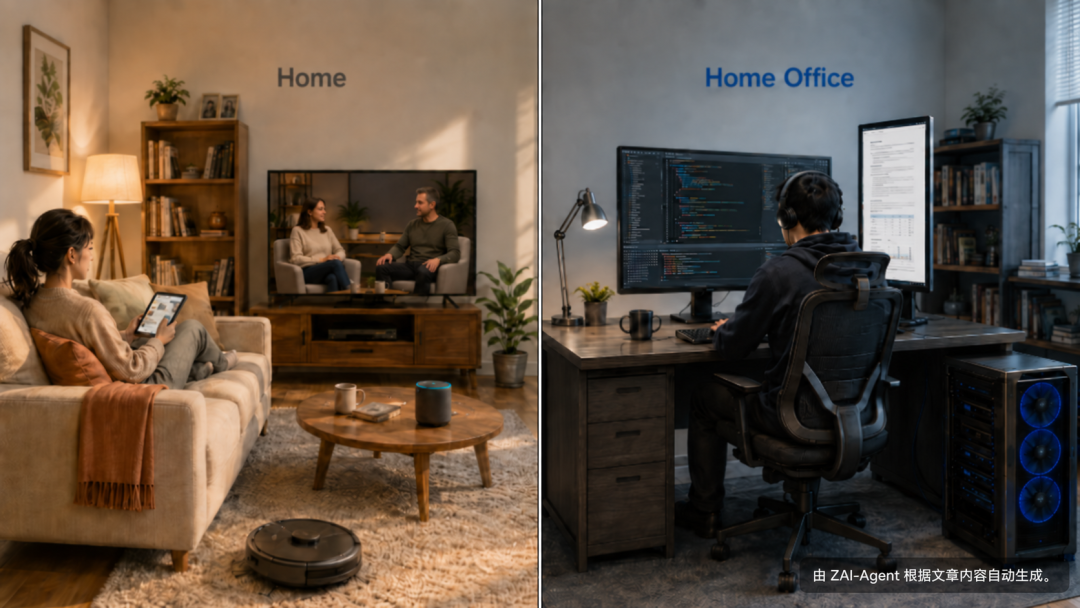
The real demand for AI in the home often revolves around daily life: NAS and mobile phones use AI to organize and categorize photos, and smart speakers can understand voice commands. However, these scenarios typically don't involve continuous, large-scale computing power consumption. More often, a user issues a command, the device runs briefly, and then returns to a standby state. The size of the household itself is also a limitation. An office computer might continuously process documents, meetings, and images every day, and AI services in enterprises face a large number of simultaneous user requests. A household typically has only a few members, and even if everyone is willing to use AI, it's difficult to generate enough high-load tasks simultaneously.
If home computing power can eventually find a viable direction, it will likely come from multimodal services that require constant backend operation. Continuous health monitoring is a relatively close concept at present: the system puts gait and posture captured by cameras, breathing and coughing characteristics from microphones, and health indicators recorded by wearable devices on the same timeline to establish an individual baseline, and then looks for abnormalities in long-term changes.
These types of tasks are difficult to delegate entirely to the cloud. Home video, daily conversations, and health metrics encompass almost all of a person's most sensitive data; if multiple data streams are uploaded around the clock, cloud storage and inference costs will accumulate over time. A more reasonable approach is to complete the main computations at home, only sending out alerts or structured results after confirming anomalies. At this point, centralized computing power finds both a technical and economic justification.
However, this only indicates that there may be tasks in the home that continuously consume high computing power; it does not prove that 190 TOPS has already found a use. Current health monitoring mainly relies on wearable devices and cameras to perform single-item tests; models and applications capable of combining multiple data streams for long-term analysis are not yet mature. In other words, while the hardware has already provided 50 TOPS or even 190 TOPS, real-world home applications that can continuously utilize this computing power remain in the realm of conceptualization.
Therefore, home computing power is not entirely without potential; it's just that the most promising needs today are still far from productization. Since the market is not ready yet, why are Lenovo, PostMotion Intelligence, and Moore's Threads rushing to develop the hardware? This is the question that deserves more discussion.
The fact that users currently have no demand does not mean that businesses and investors also have no demand.
Let's look at Moore's Threads first. For the past few years, the core story this company has repeatedly told the capital market is that it uses a single MUSA architecture to simultaneously handle different tasks such as AI computing, graphics rendering, scientific computing, and video processing. Behind this story lies a very real calculation: GPU R&D investment is enormous; from 2022 to 2024 alone, Moore's Threads accumulated losses exceeding 5 billion yuan. The money spent ultimately needs to be recouped through a sufficiently large market. The more scenarios a single architecture can be applied to, the greater the growth potential it can explain to the capital market.
“"Changjiang" takes this story a step further, moving beyond simply reusing the same architecture to covering multiple edge markets with a single chip. The same SoC is incorporated into AIBOOK as a developer device; it's made into the E300 module to target robotics and industrial customers; and then it's packed into AI Cube, thus bringing the home market into Moore's Threads' product portfolio. With each additional product form, "Changjiang's" potential market expands further, and Moore's Threads gains another example to prove MUSA's continued commercial viability.
The problem lies precisely in this last step. AIBOOK targets developers, and the E300 targets industry devices, so it's relatively easy to explain why customers need computing power. However, with AI Cube, Moore's Thread first presented a home product with 50 TOPS of computing power, but couldn't immediately explain why families would need it.
Therefore, the questions surrounding AI Cube have become even more acute: Is it a natural product of the development of household needs to a certain stage, or is it a household landing point that Moore's Threads has actively arranged for this chip in order to continue to expand the market boundaries of "Yangtze River"?
Looking at Lenovo, its reasons for launching the P7 are two layers more complex than Moore's Threads'.
The first layer comes from Tianxi AI. According to Lenovo's "one-stop-multiple-terminals" plan, personal intelligent agents need to move between PCs, mobile phones, tablets, and home devices, and the home naturally cannot be a blank spot in this terminal network. The P7 thus obtains a seemingly logical position: to be placed at home for a long time, undertaking local model operation, data storage, and capacity scheduling between different devices.
The second layer comes from Houmo Intelligent. Lenovo Capital participated in Houmo Intelligent's angel round of financing, and the P7 uses the latter's M50 in-memory computing chip. For Lenovo, incorporating the technology of its invested companies into its own complete machines not only achieves industrial synergy but also provides consumers with a product prototype of the M50.
Both of these clues can explain why Lenovo was willing to explore the P7, but they are not enough to prove that the market already needs the P7. "One device for multiple terminals" can explain that families need to access Tianxi AI, but it cannot be further deduced that this entry point must be equipped with 190 TOPS of independent computing power; the investment relationship between Lenovo and Post-Moscow can explain the choice of chip, but it cannot create a reason for consumers to buy it.
Ultimately, Tianxi AI needs a home node, Houmo Smart needs a productization opportunity, and Lenovo is willing to try putting both things on the same device. This is a logically sound industrial exploration, but a home scenario is still a gap between it and a mature business with clear needs and uses.
For Moore's Threads, PostMoore Intelligence, and Lenovo, there are certainly reasons to continue this exploration. The more markets a chip enters, the wider its commercial potential expands; the more devices an AI system connects, the more complete its "one-stop, multi-device" landscape becomes.
"Unfortunately, the capital market can value imagination, but the consumer market will only pay for its use."
Manufacturers can incorporate the home into the chip market, add AI Cube and P7 to their product portfolios, and even prepare a stage for an ecosystem that hasn't yet emerged. But until consumers truly find a need that makes it indispensable, all unused TOPS (Topics in Memory) are merely expensive, idle assets on the specifications sheet.
Therefore, the idea of AI computing chips targeting the home certainly has the potential to be a compelling story. However, whether it can become a viable business remains to be seen; it needs to be proven that these chips can actually perform other functions besides being used as alarm clocks.
